
ILS instrument Landing System
Services available through partnership
An Instrument Landing System, or ILS, is a vital tool for pilots that provides precise guidance during landings. It uses a combination of radio signals to help pilots align with the runway both horizontally and vertically. This technology ensures a more reliable landing, especially in challenging weather.
Because an ILS provides such accurate information, it lowers the decision altitude—the point at which a pilot must either continue the approach or initiate a go-around. With an ILS, pilots can safely determine the runway’s location even when visibility is poor, which makes landings safer and more efficient.
VOR/DME distance Measuring Equipment
Services available through partnership
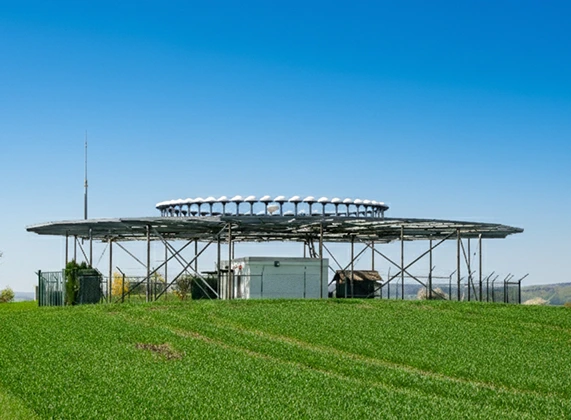
Distance Measuring Equipment (DME) is a crucial component of aviation navigation, often used in conjunction with systems like an ILS or VOR/DVOR. The system calculates the line-of-sight distance, known as “slant range,” between an aircraft and a ground station. This is achieved through a timed exchange of radio signals. An interrogator on the aircraft sends a pair of radio pulses to a transponder on the ground. After a fixed delay, the transponder returns a new pair of pulses. By measuring the time difference between sending the initial pulse and receiving the response, the aircraft’s DME system can precisely calculate its distance from the ground station, providing pilots with essential navigation data.

Radar, ADS-B
Services available through partnership
Radar and ADS-B are both essential technologies for aviation surveillance, but they operate differently. Radar (Radio Detection and Ranging) is an active system that sends out radio waves and listens for the “echo” reflecting off aircraft to determine their position. In contrast, ADS-B (Automatic Dependent Surveillance-Broadcast) is a passive, satellite-based system where aircraft themselves broadcast their GPS position, altitude, and other data once per second. This information is received by ground stations and other aircraft, providing more precise and frequent updates than traditional radar. ADS-B is crucial for modernizing air traffic control and improving situational awareness for pilots.
Rwy lights, PAPI
Services available through partnership
Runway lighting and the Precision Approach Path Indicator (PAPI) are essential for a pilot’s visual guidance during a landing, especially at night or in poor weather. The runway itself is marked by various lights: white lights define the edges, green lights mark the threshold or beginning of the runway, and red lights indicate the end. The PAPI, a critical component of this system, consists of a series of lights located beside the runway. It helps pilots maintain the correct descent angle for a safe landing. The color combination of these lights tells the pilot their position relative to the ideal glide path: a pilot seeing two white and two red lights is on the perfect path, while more white lights indicate they are too high, and more red lights signal they are too low. This simple visual cue allows pilots to make precise adjustments for a smooth touchdown.

HF and VHF radios and Antennas
Services available through partnership
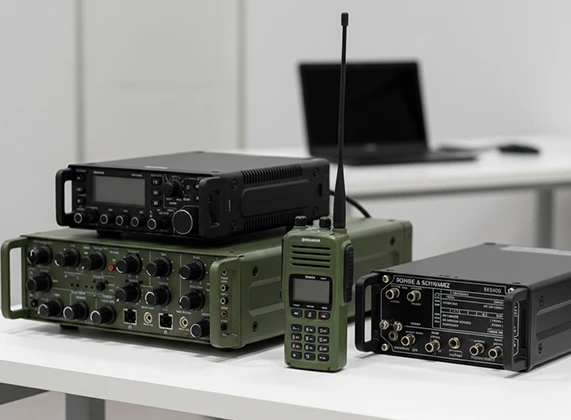
High Frequency (HF) and Very High Frequency (VHF) radios are two distinct communication systems. HF radios operate at lower frequencies (3-30 MHz) and use large antennas to enable long-distance communication by bouncing signals off the Earth’s ionosphere, a process known as skywave propagation. This makes them ideal for over-the-horizon applications like maritime or transcontinental aviation. In contrast, VHF radios function at higher frequencies (30-300 MHz) with smaller antennas. Their signals travel in a line-of-sight path, limiting their range but making them reliable and clear for short to medium-distance communication, as is standard for air traffic control and ground-to-air transmissions.